Carat Structured Wall HDPE Pipe
Large-Diameter Spirally Wound HDPE Pipe Systems — DN 600mm to DN 3000mm — Electro-Fusion Jointing — 100-Year Service Life
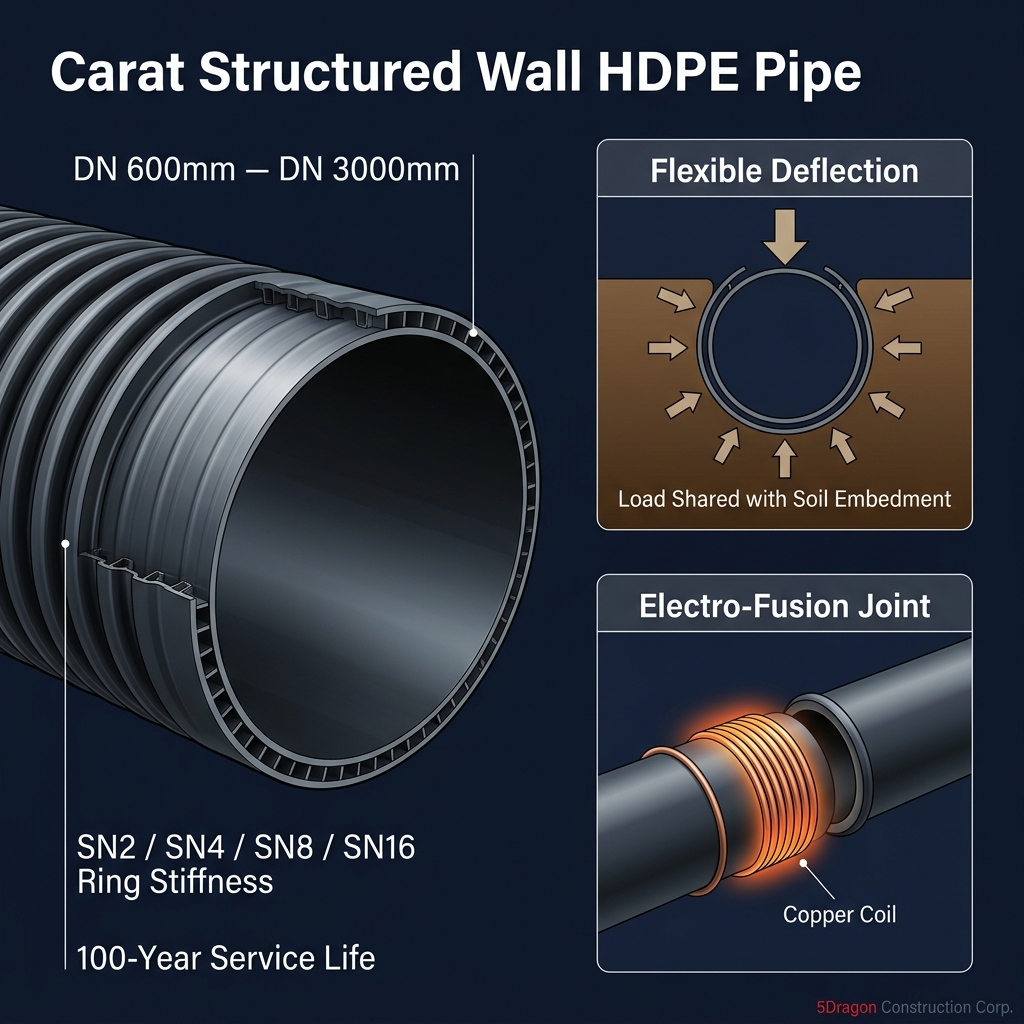
Carat structured wall pipe is produced through a spiral winding process that creates a high-stiffness, structured-profile wall without the massive weight of solid-wall pipe. The result is a lightweight, large-diameter drainage system that outperforms rigid concrete in every structural, chemical, and service-life measure.
Available from DN 600mm to DN 3000mm, with SN2 to SN16 ring stiffness options and integrated electro-fusion jointing for a permanently leak-proof underground system.
Key Features & Technical Advantages
100-Year Service Life
HDPE does not corrode, rust, or biodegrade underground. Concrete pipes crack within 30–50 years; Carat pipes outlast the infrastructure they serve.
Electro-Fusion Jointing
Copper heating coil embedded at socket end fuses each joint into a single homogeneous unit. Zero leakage, zero root intrusion, zero joint maintenance.
Flexible Load Sharing
Deflects under load and engages soil embedment to share the structural work. Maximum 5% deflection (ASTM F894). Typical field result: 1.5–2.5%.
SN2 to SN16 Classes
SN4/SN8 for municipal drainage. SN16 for airports, seaports, and railway crossings with extreme live load requirements.
Lighter Than Concrete
A DN1200mm Carat pipe is manageable with standard excavator rigging. No specialized cranes for most diameters — faster, safer installation.
Smooth Inner Bore
Manning's n = 0.009 maintained even at DN3000mm scale. Better flow, less silting, and lower pumping costs vs. rougher concrete surfaces.
Size Matrix & Electro-Fusion Procedure
Diameter & Application Guide
| Nominal ID | Stiffness | Typical Application |
|---|---|---|
| DN 600mm | SN4/SN8 | Municipal stormwater, subdivision outfalls |
| DN 800mm | SN4/SN8 | City trunk sewers, highway underdrains |
| DN 1000mm | SN4/SN8 | Large trunk stormwater mains |
| DN 1200mm | SN4/SN8 | Metro sewer interceptors |
| DN 1500mm | SN4/SN8 | Flood control, river outfalls |
| DN 2000mm | SN2/SN4 | Large infrastructure, port drainage |
| DN 2500mm | SN2/SN4 | Airport, seaport, power plant |
| DN 3000mm | Custom | Major civil/infrastructure projects |
5-Step Electro-Fusion Joint Procedure
| Step | Action Required |
|---|---|
| 1. Scrape | Remove oxide layer from full spigot OD with pipe scraper tool |
| 2. Clean | Wipe spigot OD + socket ID with 99% isopropyl alcohol |
| 3. Insert | Fully insert spigot into socket; install alignment clamp |
| 4. Weld | Connect cables, scan barcode, run fusion cycle to completion |
| 5. Cool | 30–60 min undisturbed cooling before removing clamp or backfilling |
Spiral Winding Manufacturing — How Carat Pipe Is Made
A high-output extruder feeds a continuous hollow-profile strip (square or rectangular cross-section) onto a heated rotating steel mandrel. As the mandrel rotates and advances longitudinally, the molten profile wraps spirally around it. A secondary extrusion strip is simultaneously applied over the overlapping seams, hot-fusing the spiral coils into a single, seamless pipe wall. The smooth inner liner is co-formed at the same time. This process allows precise control of the profile geometry, enabling custom diameters and ring stiffness values without expensive fixed molds.
Flexible Pipe Physics — Load Sharing with Soil
Rigid concrete pipe must resist the entire applied load (earth cover + traffic) through its wall cross-section alone. When load exceeds the pipe's structural capacity, the wall cracks. A flexible Carat pipe deflects slightly under vertical load. This lateral expansion engages the passive resistance of the compacted soil embedment surrounding the pipe. Through this mechanism, the soil and pipe work together as a composite structural system — the soil carries 80–90% of the applied load, the pipe carries the remainder. Long-term deflection is limited to 5% of inside diameter per ASTM F894 design criteria.
Major Applications
- Metropolitan drainage trunk mains: Managing monsoon stormwater volumes for large urban areas
- Seaport and harbor drainage: Saline-resistant, heavy-load-rated large bore outfall systems
- Airport runway drainage: SN16 stiffness rated for aircraft ground loads; zero-leakage fusion joints
- Power plant cooling water outfalls: Chemical inertness at elevated temperatures
- River flood control infrastructure: Pumping station outfalls, retention pond discharge, river diversions
For smaller diameters (DN150–DN600mm), see our HDPE Dual Wall Corrugated Pipe. For interior building finishes, explore uPVC Ceiling Panels. View all our quality certificates and lab reports.
Planning a Large-Scale Infrastructure Project?
Our team provides engineering support including pipe sizing, stiffness class selection, embedment design, and full certification documentation.
Get Engineering Support