
HDPE Dual Wall Corrugated Pipes
High-Performance Corrugated Pipes Engineered for Efficient Drainage & Structural Integrity
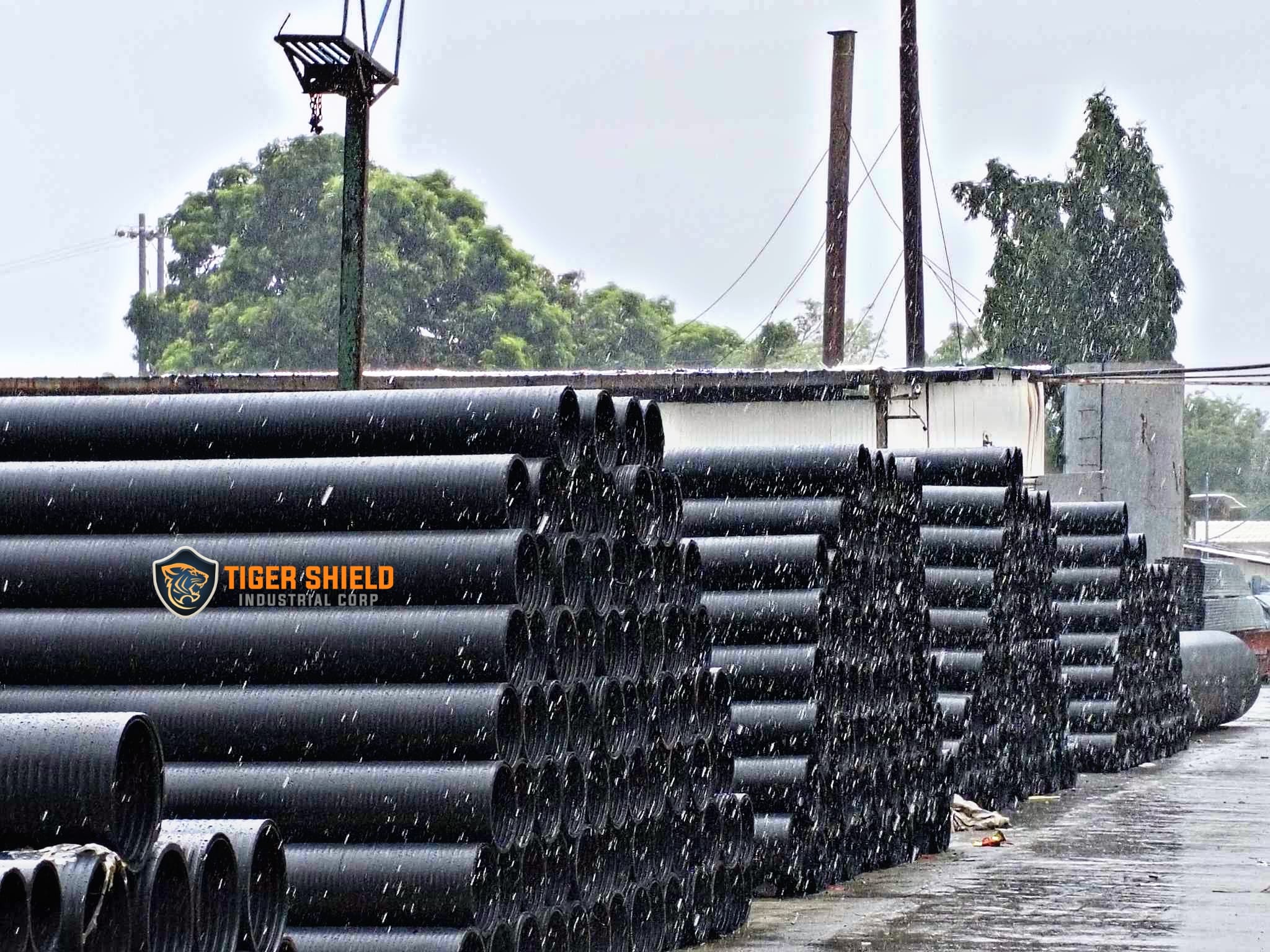
Blueribbon HDPE Dual-Wall Pipes
Our Blueribbon HDPE Dual-Wall Corrugated Pipes represent the peak of modern drainage technology. Engineered with a corrugated exterior for exceptional ring stiffness and a smooth interior to minimize friction, these pipes ensure maximum flow efficiency and durability under extreme conditions.
Compared to traditional concrete or steel pipes, HDPE is lightweight, corrosion-free, and chemically inert, rendering it immune to acidic soil or wastewater. It offers an expected service life of over 50 years, significantly reducing maintenance and replacement costs for municipal, agricultural, and highway systems.
Key Advantages & Features
High Structural Stiffness
Available in SN 4 and SN 8 stiffness classes, designed to withstand heavy backfill loads and highway traffic.
Superior Flow Hydraulics
The co-extruded smooth inner lining prevents sediment build-up and maintains excellent hydraulic flow rates.
Lightweight & Flexible
Significantly lighter than concrete pipes, reducing shipping costs and enabling fast, heavy-machinery-free installation.
100% Environmentally Friendly
Chemically inert, non-toxic, and 100% recyclable, ensuring zero contamination to surrounding soil and groundwater.
1. Introduction to Modern Gravity Drainage Systems
Gravity-flow drainage and sewerage systems form the critical backbone of municipal, commercial, and agricultural infrastructure in the Philippines. For decades, traditional concrete piping systems—commonly known as Reinforced Concrete Pipes (RCP)—and corrugated metal pipes (CMP) dominated this sector. However, changes in environmental conditions, municipal requirements, and cost restrictions have exposed their severe limitations. Rigid concrete pipes are prone to cracking due to ground shifting, earth settlement, and seismological activities. Furthermore, their heavy weight demands specialized machinery, which inflates installation costs and delays project timelines. CMP systems suffer from chemical and environmental corrosion, resulting in premature structural collapse.
Our Blueribbon HDPE Dual Wall Corrugated Pipes provide a superior alternative. By combining the exceptional chemical resistance of High-Density Polyethylene (HDPE) with a double-walled structural design, these pipes deliver high mechanical load-bearing capacity, outstanding hydraulic flow efficiency, and a service life exceeding 50 years. This comprehensive guide outlines the material characteristics, sizing catalog, hydraulic flow rates, and installation instructions for engineers, contractors, and municipal planners.
2. Material Science and Extrusion Manufacturing
High-Density Polyethylene (HDPE) is a thermoplastic polymer produced from monomer ethylene. It possesses an exceptionally high density-to-strength ratio, characterized by a polymer structure with minimal branching. This dense packing results in strong intermolecular forces and high tensile strength. To ensure long-term stability under solar radiation, the raw compound includes a minimum of 2% carbon black, which acts as a highly effective UV stabilizer during outdoor storage and transport.
The manufacturing process employs a continuous, co-extrusion technology. Two separate extruders feed molten HDPE into a single diehead. The outer wall is extruded and immediately molded into a corrugated profile, which provides circumferential ring stiffness to resist earth pressures. Concurrently, the inner wall is extruded as a smooth layer and hot-welded to the outer corrugation valleys. This dual-wall design creates a structurally sound cross-section with high hollow-core inertia, maximizing load resistance while minimizing material weight.
3. Sizing Catalog and Ring Stiffness Classes
Circumferential ring stiffness refers to a pipe's ability to resist radial deflection under external load, measured in kilonewtons per square meter (kN/m²). We supply Blueribbon pipes in two standardized stiffness classes according to ISO 9969:
- SN 4 (≥ 4.0 kN/m²): Suited for standard bury depths (0.8m to 3.0m) in low-to-medium traffic areas, residential sewage lines, and subsoil drainage fields.
- SN 8 (≥ 8.0 kN/m²): Designed for heavy-duty applications including shallow cover zones, deep trenches (up to 8.0m), highway cross-culverts, and industrial roads subject to heavy wheel loads from commercial trucks.
For custom engineering projects, we can also supply SN 16 pipes to withstand extreme loading requirements. The standard length is 6.0 meters, which balances structural integrity, shipping volume, and trench installation speed.
| Nominal Inside Diameter (ID - mm) | Nominal Outside Diameter (OD - mm) | Stiffness Class (SN) | Standard Length (m) | Gasket Inner Diameter (mm) | Approx. Weight (kg/m) |
|---|---|---|---|---|---|
| 150 | 175 | SN 4 / SN 8 | 6.0 | 152 | 1.25 |
| 200 | 232 | SN 4 / SN 8 | 6.0 | 202 | 2.10 |
| 250 | 291 | SN 4 / SN 8 | 6.0 | 253 | 3.45 |
| 300 | 348 | SN 4 / SN 8 | 6.0 | 304 | 4.80 |
| 400 | 465 | SN 4 / SN 8 | 6.0 | 406 | 7.90 |
| 500 | 581 | SN 4 / SN 8 | 6.0 | 508 | 12.50 |
| 600 | 698 | SN 4 / SN 8 | 6.0 | 609 | 18.20 |
| 800 | 930 | SN 4 / SN 8 | 6.0 | 811 | 31.00 |
| 1000 | 1162 | SN 4 / SN 8 | 6.0 | 1014 | 49.50 |
| 1200 | 1395 | SN 4 / SN 8 | 6.0 | 1217 | 71.20 |
| 1500 | 1742 | SN 4 / SN 8 | 6.0 | 1520 | 115.00 |
| 2000 | 2320 | SN 4 / SN 8 | 6.0 | 2026 | 198.50 |
4. Hydraulic Calculations and Flow Characteristics
One of the primary advantages of Blueribbon HDPE pipes is their smooth inner lining. The rate of gravity discharge is calculated using the Manning Equation:
\(Q = \frac{1}{n} \cdot A \cdot R^{2/3} \cdot S^{1/2}\)
Where:
- Q = Discharge flow rate (m³/s)
- n = Manning's roughness coefficient
- A = Cross-sectional flow area (m²)
- R = Hydraulic radius (m), which is the cross-sectional area divided by the wetted perimeter
- S = Slope or hydraulic gradient (m/m)
For HDPE pipes, Manning's roughness coefficient n is exceptionally low, ranging between 0.009 to 0.010. In contrast, concrete pipes typically exhibit an n value of 0.013 to 0.015, which increases over time due to surface erosion and biological growth. This difference allows HDPE pipes to carry up to 30% more volume than concrete pipes of the same diameter and slope. Alternatively, engineers can utilize a flatter gradient or select smaller pipe diameters to achieve identical discharge capacities, reducing excavation costs.
5. Gasket Jointing Methods and Watertight Seal Integrity
To prevent groundwater infiltration and sewage exfiltration, Blueribbon corrugated pipes feature an interlocking spigot-and-socket system. A groove on the spigot end accommodates an elastomeric rubber gasket. This gasket is made from high-grade EPDM or Neoprene rubber, providing excellent resistance to chemical attack, aging, and microbial deterioration. When pushed into the smooth socket end, the gasket compresses to form a tight seal that tolerates minor angular deflections (up to 2 degrees) without leaking.
Step-by-Step Jointing Instructions:
- Clean: Thoroughly clean both the socket and spigot ends of any dirt, grit, or debris. Clean the gasket groove on the spigot.
- Install Gasket: Place the elastomeric gasket into the first valley (for smaller sizes) or second valley (for larger sizes) from the spigot end. Ensure it is seated evenly with no twists.
- Lubricate: Apply a generous layer of joint lubricant to the inner surface of the socket and the outer surface of the gasket. Only use water-soluble, non-petroleum lubricants.
- Align and Push: Align the spigot directly with the receiving socket. Using a lever bar or puller, push the pipe home until it reaches the insertion depth mark. Do not use heavy machinery to ram the pipe, as this can damage the joints.
For industrial pressure lines or high-depth installations, butt-fusion welding or heat-shrink sleeves can be used to join plain-end pipes, creating a continuous, leak-proof line. For large diameter piping projects that demand even higher structural integrity, you can read about our Carat Structured Wall HDPE Pipe, which features integrated electro-fusion joints.
6. Detailed Installation and Embedment Guidelines (ASTM D2321)
Underground flexible pipes function through a shared load-bearing system. Unlike rigid concrete pipes, which bear the entire load, flexible HDPE pipes deflect slightly, transferring the weight to the surrounding soil. Therefore, proper trench preparation, backfill material selection, and compaction are essential to prevent structural failure. The installation must follow ASTM D2321 standards:
Trench Geometry
The trench width must be wide enough to allow for backfill placement and compaction, but not so wide that it increases the earth load on the pipe. The recommended minimum trench width is calculated as: OD + 300 mm (for sizes ≤ DN 600) and OD + 450 mm (for sizes > DN 600).
Bedding & Backfill Materials
Only native soils meeting the following ASTM classes should be used in the pipe zone:
- Class I: Angular, crushed stone (6mm to 20mm). Excellent drainage, requires minimal compaction.
- Class II: Coarse sand and gravel mixes. Good compaction characteristics, requires moderate tamping.
- Class III: Fine sand, clayey sand, or silty gravels. Requires careful compaction in thin lifts (layers of 150mm max).
Trench Detail and Placement
- Bedding: Lay a minimum of 100mm (or 150mm in rocky soils) of Class I or Class II bedding material along the trench bottom, compacted to 90% Standard Proctor Density.
- Laying: Place the pipe in the trench, starting from the downstream end with the socket facing upstream.
- Haunching: Carefully work Class I or II backfill material under the pipe haunches. This is a critical step, as empty spaces beneath the pipe can lead to structural failure.
- Initial Backfill: Place backfill in lifts of 150mm up to 300mm above the top of the pipe. Compact each layer to a minimum of 90% Proctor Density (or 95% under roadways).
- Final Backfill: Fill the rest of the trench with native soil, compacting it in layers to prevent surface settlement.
Technical Specifications
| Specification | Details |
|---|---|
| Nominal Diameter Range | 150 mm to 2000 mm (Custom sizes available upon request) |
| Ring Stiffness Classes | SN 4 (≥ 4 kN/m²) and SN 8 (≥ 8 kN/m²) |
| Standard Lengths | 6 meters & 12 meters (Plain end or integral sockets) |
| Material Composition | High-Density Polyethylene (HDPE) with anti-UV stabilizers |
| Jointing Methods | Spigot and Socket with elastomeric rubber ring gaskets, or Butt Fusion welding |
| Chemical Resistance | Excellent resistance to acids, alkalis, salts, and industrial solvents (pH range 2 to 12) |
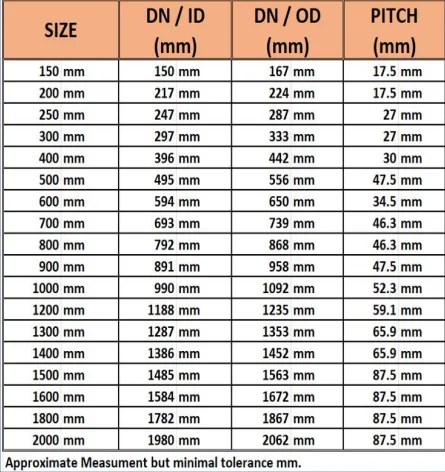
Hydraulic Flow and Bedding Diagram
Common Applications

Municipal Sewage
Ideal for gravity sewer systems, storm water collection, and residential drainage networks.

Highway Cross-Drainage
Heavy-duty culverts and underdrains for highway, railway, and runway construction.

Agricultural Irrigation
Water diversion, low-pressure subsoil irrigation, and agricultural land reclamation drainage.

Industrial Waste
Safe transport of corrosive industrial chemical waste and acidic mine drainage waters.
Need Custom Sizing or Bulk Pricing?
Get in touch with our sales team today to request a quotation, request product certifications, or schedule delivery to your project site.
Contact Sales Team